Is AI Replacing Human Creativity? The Shocking Truth Behind the 2026 Data
Is AI replacing human creativity?
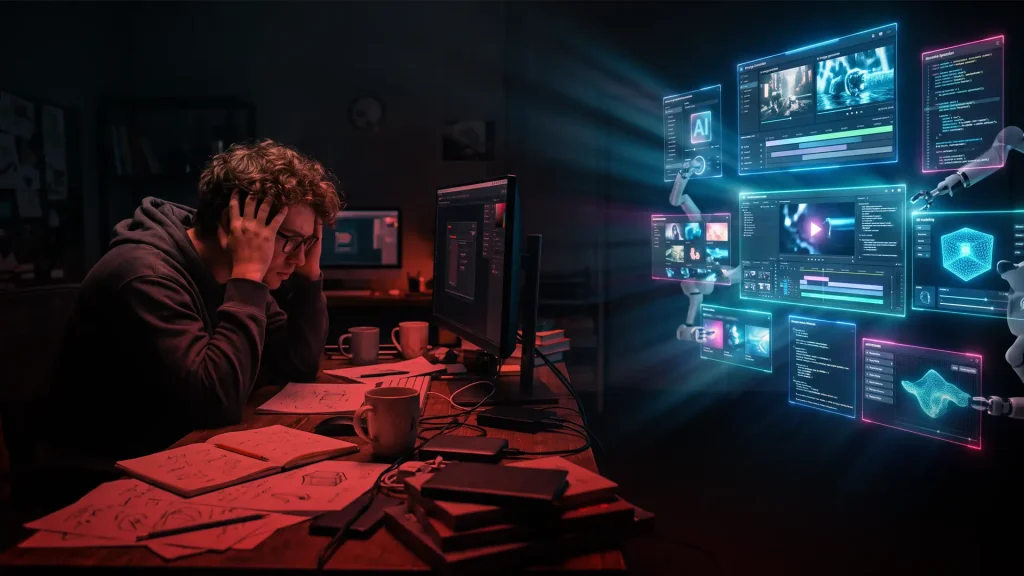
into Google and you’ll get two completely different internets.
One insists creativity was always humanity’s last stronghold and that generative AI has now breached it for good. The other insists nothing has really changed, that AI is “just a tool,” and that anyone worried about their job is being dramatic.
Both of those internets are lying to you a little.
The honest picture, once you actually go through the peer-reviewed research, the labor data, the court rulings, and what’s happening inside agencies and stock-content marketplaces right now, is messier and far more interesting. AI genuinely has closed the gap with average human creative output on some measurable tasks. At the same time, entire tiers of creative work — the generic, the templated, the purely executional — are being hollowed out, while the market is paying a growing premium for taste, direction, and originality that AI still can’t reliably produce on its own.
This article pulls together the actual 2026 data: the largest human-vs-AI creativity study ever run, Adobe’s creator and business surveys, World Economic Forum job projections, freelance marketplace numbers, and the Getty Images v. Stability AI ruling that’s reshaping how AI companies use creative work.
No hype, no doom — just what’s happening and what it means if you’re a designer, editor, illustrator, or anyone who makes a living being creative.
Related Articles
Historical Background: Automation Fears in Creative Work
Fear that machines would flatten human creativity is not new.
Photography was accused of killing painting in the 19th century; it instead pushed painters toward Impressionism and abstraction. Desktop publishing software in the 1980s was expected to wipe out typesetters and layout artists — it did eliminate that specific trade, but it also created the modern graphic design profession as we know it. Digital photography and stock-photo websites disrupted commercial photographers in the 2000s, shrinking day-rate work while creating entirely new markets for licensable imagery.
Each wave followed a similar pattern: a mechanical or digital tool absorbed the repetitive, technical part of a craft, professional practitioners who adapted moved “up the stack” into direction, curation, and judgment, and a layer of workers who didn’t or couldn’t adapt lost income.
Generative AI is now running the same playbook, but faster and across far more disciplines at once — image generation, video, music, writing, voice, and 3D modeling are all being automated simultaneously rather than one at a time.
Current Industry Overview
By 2026, generative AI is no longer an experimental add-on to creative software — it is the product.
Adobe Firefly is built into Photoshop and Illustrator. Canva’s Magic Studio absorbed Leonardo.AI’s image-generation engine after acquiring the company. NVIDIA, Autodesk, Unity, and Epic Games are racing to embed real-time generative tools into 3D and game-development pipelines. Analysts at The Business Research Company put the global generative AI in creative industries market at roughly $5.38 billion in 2026, projected to reach $14.03 billion by 2030 at a 27.1% annual growth rate, with Adobe, NVIDIA, Microsoft, Google, Autodesk, Unity, Epic Games, and traditional VFX houses like Industrial Light & Magic and Framestore all competing for share.
Adoption among working creatives is now mainstream rather than niche. Adobe’s 2026 survey of creative professionals found they now use AI on more than 40% of the projects they produce, with many relying on AI tools for at least half their working week, and nearly nine in ten saying generative AI has improved the quality of their work.
Its separate Creators’ Toolkit Report, run with The Harris Poll across more than 16,000 creators in eight countries, found 87% of creators using creative AI say it has accelerated the growth of their business or audience, and 75% describe it as integrated or essential to their workflow. Independent coverage of the same report has noted a real caveat: the survey defines “creators” as social-first digital publishers rather than the full traditional creative workforce of art directors, cinematographers, and agency designers, whose relationship with AI looks different day to day.
What the Science Actually Says About AI vs. Human Creativity
This is the part most articles skip, and it’s the part that actually answers the question in the headline.
The most rigorous evidence comes from a January 2026 study published in Scientific Reports (part of the Nature group), led by Professor Karim Jerbi at the Université de Montréal, with contributions from Turing Award-winning AI pioneer Yoshua Bengio, and researchers from Concordia University, the University of Toronto, Mila, and Google DeepMind. It’s the largest human-versus-AI creativity comparison ever conducted, comparing more than 100,000 human participants against leading generative AI models.
The result: AI has crossed what researchers call a symbolic threshold of average human creativity, while still lagging well behind the most creative individuals. On standardized divergent-thinking tasks — tests that ask a subject to generate many original ideas quickly — models like GPT-4 now outperform the average person, something that was considered essentially impossible before this study.
But the top tier of human originality remains firmly out of reach for AI.
A companion write-up of the same research made a point worth sitting with: the study found AI creativity is not autonomous — it depends heavily on how humans phrase and guide the prompts, and that instructions built around word etymology and structure produced meaningfully more original AI output. In other words, AI’s creativity score is really a human-AI collaboration score. The person prompting the model is doing real creative work, even when the model produces the words or pixels.
A separate large-scale industry analysis reached a complementary conclusion using standard “alternative uses” creativity tests, where a model is asked to generate as many novel uses for an everyday object as possible: AI models generated far more ideas, in far less time, than human participants, but humans still scored higher on originality, lateral thinking, and business-relevant value. Translation: AI wins on volume, humans still win on the ideas that actually move a brief forward.
Academic reviews of human-AI collaboration reinforce the same pattern. A 2024–2025 literature synthesis on co-creativity noted that generative AI tools are associated with a documented rise in creative output — artists using such tools report producing roughly 50% more artwork, alongside higher audience engagement — without that output replacing the human decision-making driving it. Separate experimental research from Swansea University, involving more than 800 participants designing virtual products, found that AI-generated concept galleries actually deepened human engagement and led to better final designs rather than short-circuiting the creative process.
The bottom line from the science: AI has genuinely, measurably matched or exceeded average human creative output on specific, narrow tasks. It has not matched top-tier human originality, and its output quality is directly tied to the skill of the human directing it.
Detailed Analysis: Where AI Is Winning, and Where It Isn’t
Breaking “creativity” into its component parts makes the picture much clearer than a single yes/no verdict.
Where AI is winning outright:
- Generic stock-style photography and B-roll footage
- First-draft concept exploration and mood-boarding
- Rough layout and template generation
- Background removal, upscaling, retouching, and other technical Photoshop tasks
- Basic copywriting, captions, and ad variant generation at scale
- Reference and pose generation for illustrators and animators
Where humans still hold a decisive advantage:
- Original art direction and taste — deciding which AI output is actually good
- Emotionally resonant storytelling tied to lived experience
- Brand strategy and creative concepts grounded in a specific market or client
- High-stakes originality (award-winning campaigns, signature illustration styles)
- Client relationships, briefing, and the judgment calls AI can’t be accountable for
An analyst writing about AI-driven job displacement summarized this split precisely: AI is not eliminating creative work wholesale, but it is dramatically compressing demand at the “execution level” while increasing the value placed on strategic thinking and aesthetic judgment. That’s the real shape of the disruption — not a straight line from “creative job” to “no job,” but a squeeze on the bottom of the skill ladder and a widening reward at the top.
Statistics and Facts: The 2026 Numbers
- The global generative AI in creative industries market is valued at roughly $5.38 billion in 2026, growing at a 27.1% compound annual rate toward $14.03 billion by 2030.
- Creative professionals now use AI on more than 40% of the projects they work on, according to Adobe’s 2026 survey.
- 75% of surveyed creators describe generative AI as “integrated or essential” to their workflow, per Adobe’s Creators’ Toolkit Report, though 40% said AI-assisted content consistently performs better and 63% said it made them feel more confident as creators.
- Globally, the World Economic Forum’s Future of Jobs research projects that by 2030, 170 million new jobs will be created and 92 million displaced by AI-driven disruption, for a net gain of roughly 78 million roles — but the workers losing jobs and the workers filling new ones are rarely the same people.
- The Forum’s own survey of business leaders found more than half of executives expect AI to displace existing jobs, while only 24% expect it to primarily create new ones.
- On freelance marketplace Upwork, category-level data cited in labor research showed writing and translation job volume falling roughly 30% year-over-year at points in the disruption, with graphic design postings down 17% even as AI-augmented creative roles grew 45%; a 2024 survey of nearly 800 creative freelancers found 26% of illustrators and 36% of translators had already lost work directly to generative AI.
- Upwork’s own 2026 skills data shows the inverse trend for AI-fluent freelancers: skills explicitly referencing AI grew 109% year-over-year, with AI video generation and editing demand up 329% and AI image generation also surging.
- In the U.S., the Bureau of Labor Statistics projects overall graphic designer employment to grow only about 2.1% through 2034 — slower than the average occupation — while explicitly noting that automated design tools such as AI may reduce the need for companies to hire freelance graphic designers. Meanwhile roles that blend design with digital/web skills are projected to grow faster and pay significantly more.
- The stock photography and video industry — directly relevant to Adobe Stock contributors — is undergoing real structural change: platforms have split their policies, with Adobe Stock now roughly 48% AI-generated content, with around 29 million new AI images uploaded monthly, while Getty Images banned externally generated AI submissions entirely and Shutterstock now restricts AI uploads to a separate, lower-payout collection.
- Following the November 2025 UK High Court ruling, Getty Images stated that the court confirmed its copyright-protected works were used to train Stability AI’s Stable Diffusion model, and that AI models can be treated the same as tangible articles under copyright law — even though Getty’s core infringement claim was ultimately dismissed.
(A word of caution for readers: several “creative industry AI statistics” round-ups circulating online in 2026 cite figures that don’t survive basic scrutiny — percentages above 100%, uncredited “revenue collapse” numbers, and sweeping claims with no named methodology. This article deliberately excludes those and sticks to data traceable to a named survey, government agency, or academic study.)
Real-World Examples and Case Studies
The Université de Montréal creativity study. As detailed above, this is the most methodologically serious head-to-head test of AI versus human creativity to date, and its finding — AI beats the average human, loses to the best humans — is the single most quoted data point in the 2026 debate for good reason.
Adobe’s Creators’ Toolkit Report. With over 16,000 respondents across eight countries, this is the largest survey of working creatives and their AI habits currently available, though its “creator” definition skews toward social-first digital publishers rather than traditional agency or studio staff — worth remembering when Adobe’s more optimistic numbers get cited elsewhere.
Advertising agency consolidation. Following its completed $13.3 billion acquisition of Interpublic Group, Omnicom cut roughly 4,000 jobs and folded three long-running creative agency networks — DDB, FCB, and MullenLowe — into larger units, reducing the combined group’s headcount from about 128,000 to 105,000. While AI is only one factor in large-agency consolidation, industry analysts have pointed to AI-driven production efficiency as part of the rationale behind shrinking headcount even as billings hold steady.
Getty Images v. Stability AI. The UK’s first major AI copyright ruling, decided in November 2025, dismissed Getty’s core copyright infringement claims against Stability AI’s Stable Diffusion model but found in Getty’s favor on a narrower trademark claim, after Getty’s watermark appeared in AI-generated outputs. The court also established, for the first time, that an AI model can in principle be treated as an “article” capable of infringing copyright under UK law, even though it exists only as an intangible digital copy — a precedent likely to matter far more in future cases than this one’s actual outcome.
Stock content platforms diverging on policy. Rather than one industry-wide response to AI, stock platforms have split. Some, like Getty Images and iStock, have restricted AI content to protect the “verified human” value proposition; others, like Adobe Stock and Freepik, have leaned into AI generation as a growth driver. For contributors, this means the platform you upload to now materially changes both your competition and your payout structure.
Expert Opinions
Researchers behind the Université de Montréal study were careful to frame their own results as a call for collaboration, not competition. Study lead Professor Karim Jerbi said the work should push the field to rethink what creativity actually means now that machine and human capabilities can be measured directly against one another.
At a 2026 gathering of global creative leaders covered by Forbes, participants argued that generative AI is shifting the location of creative value rather than erasing it — one creative director put it succinctly, distinguishing tactical prompting from the deeper discipline of creative direction, and the broader group agreed that AI collapses the distance between imagination and execution, making human judgment and taste more important, not less.
Labor economists studying the World Economic Forum’s projections strike a more cautious tone. Coverage of the Forum’s Future of Jobs work notes that roughly 120 million workers globally face medium-term redundancy risk over the next three to five years, and that the gap between newly created roles and displaced ones is fundamentally a reskilling problem, not a headcount problem — the people losing creative jobs today are rarely the same people qualified to fill the new AI-adjacent roles being created.
Advantages of AI in Creative Work
- Speed and iteration. Concepts that once took days of exploration can be roughed out in minutes, freeing time for refinement.
- Access and democratization. Independent creators without large budgets can now produce studio-quality visuals, video, and audio.
- Expanded creative range. AI-generated reference material and concept galleries have been shown in controlled studies to widen the pool of ideas creatives explore before settling on a direction.
- New income streams. Skills like prompt engineering, AI workflow design, and AI-assisted retouching are among the fastest-growing paid skills on freelance marketplaces.
- Reduced grunt work. Background removal, resizing, format conversion, and rough drafts — the least creatively satisfying parts of many jobs — are increasingly automatable.
Disadvantages and Risks
- Commoditization of entry-level work. The tasks junior designers, illustrators, and photographers traditionally used to build a portfolio and earn income are precisely the tasks AI now does fastest and cheapest.
- Market saturation and price collapse. Contributor payout rates on stock platforms have compressed as AI-generated submissions have multiplied far faster than buyer demand.
- Legal uncertainty over training data. Ongoing litigation, including the Getty Images v. Stability AI case, means the legal status of AI models trained on copyrighted creative work remains unsettled in most jurisdictions.
- Homogenization risk. When large numbers of creators lean on the same handful of AI models, output can converge toward similar aesthetics unless directed with real originality.
- Erosion of foundational skills. Some educators and working designers worry that over-reliance on AI-generated concepts short-circuits the skill-building that comes from struggling through a blank page.
Common Myths About AI and Creativity
Myth 1: “AI is already more creative than any human.” False, per the actual peer-reviewed research — AI now beats average human creativity scores on specific standardized tests, but not top-tier human originality.
Myth 2: “AI is just a tool, nothing has really changed for creative careers.” Also false. Labor market data shows real, measurable displacement at the entry and execution level, even as demand and pay rise for AI-fluent, strategy-focused creatives.
Myth 3: “Every stock photographer and illustrator is being wiped out.” The reality is more segmented: generic, “businessman shaking hands”-style content has genuinely lost value, while authentic, niche, and editorial imagery remains in demand and is increasingly protected by platform policy.
Myth 4: “Legal rulings have settled whether AI training on copyrighted art is legal.” Not even close. The Getty v. Stability AI ruling was a mixed, narrow decision on specific UK legal doctrines, and courts in the US and elsewhere are still actively litigating similar questions.
The Legal Battlefield: Copyright, Training Data, and Ownership
The single most consequential legal event of the past year for creative professionals is the November 2025 UK High Court ruling in Getty Images (US) Inc & Ors v. Stability AI Limited. Getty had accused Stability AI of scraping more than 12 million photographs, captions, and metadata to train its Stable Diffusion image generator without authorization.
The court’s decision was genuinely split. It dismissed Getty’s core “secondary copyright infringement” claim, ruling that Stable Diffusion — once trained — no longer contained a literal “copy” of Getty’s images and therefore wasn’t itself an infringing article under UK law. But Getty won on a narrower trademark point: the court found that Stable Diffusion’s inclusion of Getty’s watermarks in AI-generated outputs did infringe Getty’s trademarks, and rejected Stability’s argument that responsibility for that infringement belonged to the end user rather than the model provider.
Legal analysts have flagged the case’s broader significance beyond its immediate result: the judge established that an AI model can in principle qualify as an “article” capable of secondary copyright infringement under UK law, even though it exists only as an intangible electronic copy — opening the door, in theory, to future claims against AI systems on similar grounds, even though this specific claim failed. Getty has said it will carry the UK ruling’s factual findings into its still-ongoing US litigation against Stability AI.
For working creatives, the practical upshot right now is not a clean legal victory or defeat — it’s prolonged uncertainty. Policy responses are diverging by platform and by country: some stock agencies ban AI-trained submissions outright, others embrace them with lower payouts, and governments including the UK are actively drafting new transparency and opt-out rules for AI training data that could reshape the landscape again within the next year.
Future Predictions
Expect the following trends to define the next 24 months:
- A widening split between “execution” and “direction” creative roles, with pay and demand diverging sharply between the two.
- Continued consolidation in agencies and stock platforms, as AI-driven efficiency lets fewer people handle more output.
- New legal precedent as US courts rule on cases parallel to Getty v. Stability AI, likely tightening training-data transparency requirements.
- A premium on verified-human and “AI-proof” content categories — authentic photography, distinctive illustration styles, and culturally specific work that generic models struggle to replicate.
- AI literacy becoming a baseline hiring requirement, similar to how Photoshop proficiency became non-negotiable in the 2000s.
Career Impact
For individual creatives, the data points toward a clear strategic shift rather than a doom scenario. Upwork’s own analysis argues that AI allows designers to take on more projects and expand their service offerings rather than simply replacing them, and its 2026 skills report shows established creative categories like graphic design holding steady in demand even as AI-specific skills post triple-digit growth.
At the same time, the U.S. Bureau of Labor Statistics is explicit that AI-driven automated design tools may reduce demand for freelance graphic designers specifically, and analysts tracking the freelance market have found meaningful, already-realized income loss among illustrators and translators.
The practical career advice implied by this data: build skill in the layer AI can’t easily replicate — art direction, brand strategy, original illustration style, client relationships, and editorial judgment — while actively learning to direct AI tools rather than compete with them on raw output volume.
Business Impact
For agencies, studios, and marketing teams, generative AI is primarily a margin story. Faster production cycles mean the same billings can be delivered with smaller teams, which is part of what’s driving consolidation moves like the post-merger job cuts across Omnicom’s newly combined agency networks.
For brands and Adobe Stock buyers, AI has lowered the cost floor for routine visual content while increasing willingness to pay for verified-authentic or highly specialized imagery that AI still struggles to produce convincingly.
Businesses that treat AI purely as a cost-cutting tool risk commoditized, forgettable output; those that pair AI speed with strong human direction are the ones capturing both the productivity gains and the audience engagement Adobe’s surveys associate with AI-assisted creative work.
Conclusion
“Is AI replacing human creativity” is the wrong question if you want a useful answer — it’s really two separate questions wearing one headline.
Is AI capable of producing creative output that matches an average human on a narrow, measurable task? Yes, and the peer-reviewed evidence on that point is now solid.
Is AI replacing the deeper, judgment-driven, taste-and-direction work that separates a good creative professional from a competent one? Not yet, and not for lack of trying — the data consistently shows humans retaining a clear edge on originality, strategic relevance, and the kind of creativity that’s grounded in lived experience.
What’s actually happening across design, stock content, advertising, and freelance creative work in 2026 is a sorting process: routine, templated, and easily-replicated creative labor is losing value fast, while direction, taste, and originality are becoming more valuable, not less. That’s genuinely disruptive for anyone whose income depended on the execution layer. It’s also, based on the evidence, an opportunity for creatives willing to move up the value chain and treat AI as a collaborator rather than either a threat or a replacement.


