
Is AI Replacing Humans? The 2026 Data on Jobs, Creative Work & the Future
Is AI replacing humans?
into Google today, you’ll get two completely different internets. One is full of CEO memos, layoff trackers, and headlines about a “white-collar recession.” The other is full of economists insisting that, so far, the employment data looks remarkably normal.
Both are true at the same time, and that contradiction is exactly why the question is so hard to answer honestly.
This isn’t a hype piece and it isn’t a doom piece. It’s a data-first look at what’s actually happening in mid-2026: which jobs are shrinking, which are growing, which industries — including graphic design, video editing, and other creative fields — are feeling it first, and what the most credible economists studying this in real time are finding when they look at actual payroll and usage data rather than predictions.
The short version: AI is not replacing “humans” as a category. It is replacing specific tasks, and in a meaningful and growing number of cases, specific jobs — concentrated heavily among entry-level, routine, and highly standardized work. Whether that adds up to “AI is replacing humans” for you personally depends almost entirely on what you do and how exposed those particular tasks are.
Historical Background: We’ve Asked This Question Before
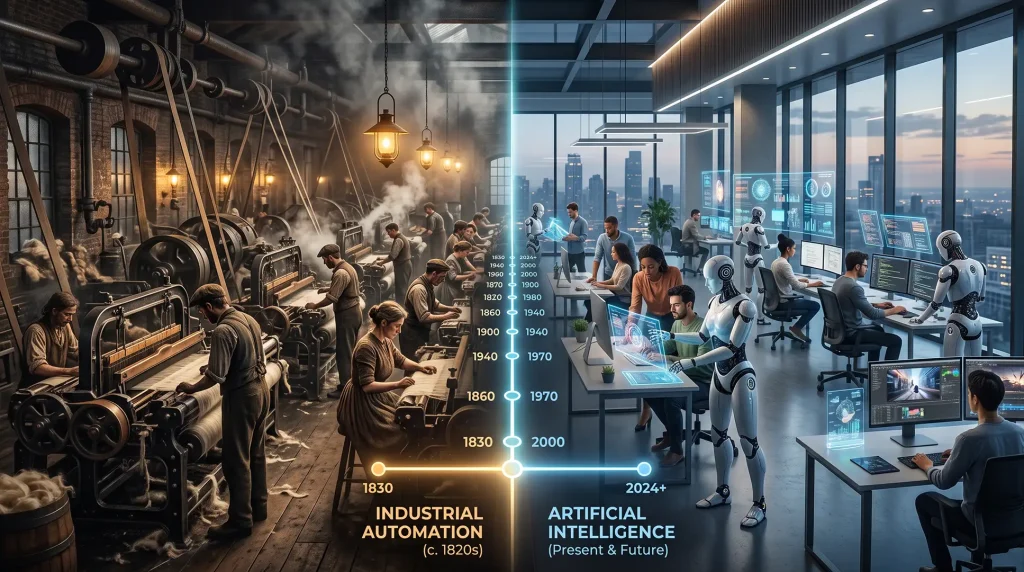
Fear of machines replacing human labor is not a 2023 invention. It goes back at least to the Luddite movement of the early 1800s, when English textile workers destroyed power looms and mechanical knitting frames out of fear the machines would make their skills worthless. Economists of the era, including David Ricardo, took the concern seriously enough to write about it directly, and some, like Thomas Mortimer, argued machines could displace labor permanently rather than temporarily.
The Luddites were not wrong about the short-term pain. Historical wage data shows many handloom weavers experienced real, lasting declines in income and never fully recovered economically. But the textile industry as a whole didn’t shrink — it exploded. As machines automated more of the weaving process, output per worker in American cloth production rose by roughly 50x over the 19th century, and the labor required per yard of cloth fell by around 98%. Cloth became so much cheaper that demand surged, and the number of weavers in America actually quadrupled between 1830 and 1900 — they just did a different, machine-assisted version of the job.
A similar story played out with the rise of computers in the mid-20th century. Widespread fears that automation would wipe out clerical work, bookkeeping, and data entry didn’t produce mass unemployment; instead, computerization created entire new fields — software development, IT support, cybersecurity — that didn’t previously exist.
Economists studying long technological cycles, including Nobel laureates Daron Acemoglu and Simon Johnson, frame this as a tension between two effects: a displacement effect, where machines directly substitute for human tasks, and a reinstatement effect, where the same technology creates entirely new categories of work. In the early Industrial Revolution, displacement dominated and workers suffered. In the 20th century, reinstatement caught up and wages rose broadly. Since the late 20th century, in the computer and internet era, wages in many advanced economies have grown much more slowly even as productivity kept climbing — a gap some economists point to as an early warning sign for how AI could play out differently this time.
The honest historical lesson isn’t “technology always creates more jobs than it destroys” or “this time is different.” It’s that the distribution of gains and losses — who benefits, who is displaced, how fast, and with what support — is the part that actually determines whether a technological shift feels like progress or a crisis. That’s the lens worth applying to AI.
Current Industry Overview: Where Things Actually Stand in 2026

By mid-2026, AI’s fingerprint on the labor market is visible in three separate data streams that don’t always agree with each other:
1. Exposure estimates (what AI could theoretically do). The International Monetary Fund estimates that almost 40% of global employment is exposed to AI in some way, rising to roughly 60% in advanced economies. Goldman Sachs Research puts the number even higher, estimating AI could expose the equivalent of 300 million full-time jobs worldwide and automate tasks equal to 25% of all U.S. work hours.
2. Layoff attribution (what companies say is happening). Outplacement firm Challenger, Gray & Christmas tracked roughly 99,470 U.S. job-cut announcements between 2023 and March 2026 in which employers explicitly cited AI — about 3.5% of all layoff announcements over that period, though AI became the single most-cited reason for cuts in multiple months of 2026, accounting for around 23% of announcements in some months. That’s a large gap from the 40–60% “exposure” number, and it’s the central tension in the entire debate: exposure is a leading indicator of what’s possible, not a running count of what’s already happened.
3. Net employment (what’s actually showing up in payrolls). The World Economic Forum’s Future of Jobs research projects roughly 92 million jobs will be displaced globally by 2030, offset by about 170 million newly created roles — a projected net gain of roughly 78 million jobs worldwide. Anthropic’s own Economic Index, drawn from real Claude usage data, found that about 49% of jobs have seen Claude used for at least a quarter of their tasks, but found no clear economy-wide unemployment signal in the most AI-exposed occupations as of early 2026.
The one place where the data across multiple independent research groups does agree: entry-level hiring is down disproportionately in AI-exposed occupations, even while overall employment in those same fields holds roughly steady. That single finding is arguably the most important labor-market data point of the whole AI era so far, and we’ll come back to it in detail in Section 11.
Detailed Analysis: Automation vs. Augmentation
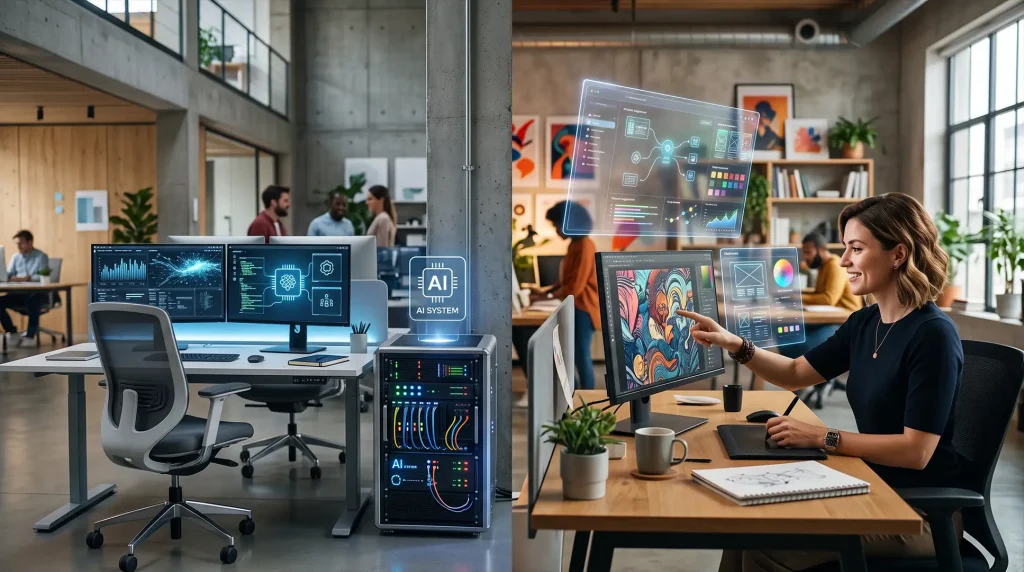
The most useful mental model economists use isn’t “AI replaces jobs” — it’s the distinction between automation and augmentation.
- Automation means AI completes a task independently, with a human only reviewing or not involved at all. This is what most people picture when they worry about “replacement.”
- Augmentation means AI assists a human who remains in control of the task — drafting a first version, checking work, speeding up a repetitive step.
Anthropic’s Economic Index — built from real, privacy-preserving analysis of Claude conversations rather than surveys or predictions — found that on its consumer product, augmentation (52% of conversations) has actually overtaken automation (45%) as the dominant pattern of use. But that ratio flips dramatically on the API, where roughly 77% of enterprise usage is automation-heavy — because API workflows tend to be more rigid and rule-based, requiring less human judgment to complete. Anthropic itself flags this as a meaningful signal: as more companies migrate from chat-style tools to API-based automated workflows, “more imminent transformation of work” becomes more likely.
A separate, more granular Anthropic labor-market study introduced a metric called AI Coverage — the share of a job’s real-world tasks that AI is already completing in practice, not theoretically capable of completing. Early results found computer programmers already had roughly 75% of their tasks covered by AI in actual usage, one of the highest coverage rates measured of any occupation studied.
MIT researchers studying this from a different angle — testing more than 40 AI models against 11,500 real occupational tasks from the U.S. Labor Department’s database — found AI models could complete about 50% of text-based tasks at a “minimally acceptable” level in 2024, rising to roughly 65% by 2025, and projected to reach 80–95% by 2029. Crucially, the researchers stress that “good enough to pass a quality check” is not the same as “reliable enough to run unsupervised” — a gap that shows up repeatedly in the productivity research below.
Research Findings and Statistics

Pulling together the most-cited, most methodologically credible figures as of mid-2026:
Broad labor market:
- 92 million jobs projected displaced globally by 2030, against 170 million newly created — a net gain of roughly 78 million (World Economic Forum, Future of Jobs Report).
- Nearly 40% of global employment is exposed to AI, rising to about 60% in advanced economies (IMF).
- AI could expose the equivalent of 300 million full-time jobs worldwide and automate tasks equal to 25% of U.S. work hours (Goldman Sachs Research).
- About 49% of jobs have had Claude used for at least a quarter of their tasks, though this share held roughly flat between two Anthropic measurement periods in late 2025 and early 2026 (Anthropic Economic Index).
- U.S. employers cited AI in roughly 99,470 layoff announcements between 2023 and March 2026 — about 3.5% of all announced cuts over that period, but the single most-cited reason in several individual months of 2026 (Challenger, Gray & Christmas).
Productivity research:
- A controlled Stanford/MIT study of over 5,000 customer-support agents found AI tools raised productivity (issues resolved per hour) by 14% on average, and by up to 34–35% for newer, lower-skilled workers specifically — with almost no measurable gain for the most experienced agents.
- A study of software developers using an AI coding assistant found output rose 26% on average across experiments, with junior developers gaining 27–39% versus 8–13% for senior developers.
- A broad review of task-level productivity studies found typical productivity gains of 20–60% in controlled lab settings, but a more modest 15–30% in most real-world workplace settings.
- Roughly half of the time workers spend using large language models goes toward managing the AI itself — quality control, bias-checking, prompt refinement — which eats into the raw productivity gain (research cited by MIT’s Initiative on the Digital Economy).
Creative industries specifically:
- 75% of designers now use AI tools in their workflow, up from 35% in 2023, and 36% of companies have already replaced at least one design task with AI — though 67% of designers describe AI as a complement to their work rather than a replacement for it (AIGA/Colorlib design statistics).
- Job listings requiring AI-tool fluency rose from 3% to 32% of all graphic design postings in two years.
- Stock photography and stock-asset platforms saw an estimated 20–30% revenue decline as AI-generated imagery replaced traditional stock purchases.
- U.S. graphic design employment is projected to grow only about 2% through 2032–2034 — far slower than the broader labor market — though the U.S. Bureau of Labor Statistics still expects roughly 22,800 annual openings from turnover, retirements, and career changes.
- In entertainment specifically, a CVL Economics study cited by The Hollywood Reporter estimated more than 118,000 U.S. film, TV, and animation jobs could be disrupted by AI video tools by 2026, and Los Angeles County alone lost roughly 41,000 entertainment-industry jobs over three years. In the same study, about a third of entertainment executives predicted AI would meaningfully displace 3D modelers by the end of 2026, roughly a quarter expected an impact on graphic designers and compositors, and about 15% flagged storyboard artists, illustrators, and animators as near-term vulnerable.
- Despite that disruption, business demand for design work is not collapsing: 47% of businesses surveyed increased their graphic-design budgets over the past year, and 53% expect to increase spending further over the next 12 months, according to Clutch.co’s 2026 industry research.
Entry-level and generational impact:
- Employment for workers aged 22–25 in the most AI-exposed occupations fell by roughly 13% (and by some later estimates, up to 16%) since generative AI’s widespread adoption, according to Stanford Digital Economy Lab research using ADP payroll data covering millions of U.S. workers — while employment for older workers in the very same occupations held steady or grew.
- The decline is driven primarily by stalled hiring, not mass layoffs — young people simply aren’t being hired into the entry-level roles that used to exist, because those roles were disproportionately built from the exact tasks (information retrieval, summarizing, drafting, formatting) that AI now handles first.
Real-World Examples and Case Studies

Amazon. CEO Andy Jassy told employees directly that as the company deploys more generative AI and AI agents, “we will need fewer people doing some of the jobs that are being done today” and that this will reduce Amazon’s total corporate workforce in the coming years. Amazon cut roughly 14,000 corporate jobs in late 2025 and another 16,000 in January 2026 — its steepest cuts in company history — though Amazon has stated AI was not the stated reason for the majority of those specific cuts, illustrating how tangled “AI layoffs” and ordinary corporate restructuring have become in practice.
Salesforce. CEO Marc Benioff confirmed on a podcast that Salesforce reduced its customer-support headcount from about 9,000 to roughly 5,000 employees as AI agents absorbed more support volume, saying plainly that the company needed fewer people. Salesforce has simultaneously said it plans to hire new, AI-skilled employees in other areas — a pattern (cut in one place, hire in another) that recurs across multiple companies in the tracked data.
Oracle, Meta, Block, and Atlassian. Each has publicly tied recent layoffs, at least in part, to AI investment or AI-driven restructuring — Oracle cutting thousands of roles while pouring capital into AI infrastructure, Meta planning cuts reported to affect a meaningful share of its workforce partly to offset the cost of AI-assisted work, Block cutting close to half its staff in a restructuring that prioritizes AI, and Atlassian cutting about 10% of its workforce to fund further AI investment.
UPS and logistics. UPS announced roughly 12,000 management job cuts in 2024 with explicit references to generative AI, followed by another 20,000 cuts in 2025 alongside a plan to automate around 400 facilities — one of the clearest examples of AI-linked disruption reaching outside white-collar office work.
The stock-imagery industry. Traditional stock photo and video platforms — long a staple revenue source for freelance photographers and designers, and directly relevant to creators who sell on marketplaces like Adobe Stock — saw an estimated 20–30% revenue decline as AI image generators like Midjourney, Firefly, and DALL-E let buyers generate custom visuals instead of licensing existing ones.
Expert Opinions: Both Sides of the Debate

The “this is already happening” camp. Stanford economist Erik Brynjolfsson, whose research team built the “Canaries in the Coal Mine” study on entry-level hiring, has stress-tested his own findings against every major counter-explanation — interest rates, remote work, removing the tech sector entirely — and says the pattern holds every time he re-runs it. He describes the current moment bluntly as one where researchers are “flying blind” without better real-time labor data, and says the generational hiring gap “is not going away.”
The “it’s more nuanced than headlines suggest” camp. MIT economist Daron Acemoglu, a 2024 Nobel laureate in economics, has become one of the most prominent voices pushing back on the more alarmist AI-jobs narratives, arguing (alongside co-author Simon Johnson) that whether AI helps or harms workers depends heavily on whether it’s deployed to create new tasks and reinstate labor demand, or purely to automate existing tasks away. — a framing explored in depth in Knowable Magazine’s coverage of the debate
The “measure what’s actually happening, not what’s theoretically possible” camp. MIT Sloan researchers behind the influential Generative AI at Work studies found that productivity gains are real but heavily concentrated among newer and lower-skilled workers, with senior, highly experienced workers seeing close to zero measurable benefit from the same tools — a finding that complicates the simple story that AI benefits everyone equally, and one that also runs counter to the idea that AI mainly threatens junior workers’ jobs while senior experts are the ones actually replaced.
The corporate leadership camp. Executives are notably split even among themselves. Some, like Amazon’s Jassy, have stated directly that AI-driven efficiency will shrink total headcount. Others, like Salesforce’s Marc Benioff, have publicly downplayed the idea that AI is driving mass white-collar layoffs — a claim that sits uneasily next to Salesforce’s own AI-linked cuts to its support organization in the same period.
Advantages of AI in the Workplace

- Meaningful productivity gains, especially for newer and less experienced workers, who see the largest measurable improvement from AI tools — in some studies, 2–3x the gain seen by senior staff.
- Lower barriers to skilled output. In customer support and coding studies, AI-assisted novices performed comparably to, or better than, unassisted staff with months more experience — effectively compressing the learning curve.
- Net job creation at the macro level, at least in current projections. Multiple major forecasts (WEF, Goldman Sachs) still project more jobs created than destroyed through 2030, even as they acknowledge painful transitions for specific roles and workers along the way.
- New job categories entirely. LinkedIn data shows postings for AI trainers and prompt engineers up roughly 300% since 2023, AI ethics roles growing about 150% year-over-year, and entirely new specialties — MLOps engineers, AI integration specialists, data-labeling teams — emerging at scale.
- A wage premium for AI-literate workers. Workers who demonstrate AI proficiency are commanding pay premiums estimated at 20–56% above peers in equivalent roles across several labor-market studies, and PwC’s Global AI Jobs Barometer found job numbers rising even in highly automatable roles when workers apply AI skill on top of them.
Disadvantages and Risks

- A widening entry-level gap. The clearest and most consistent finding across independent research groups: young workers (22–25) in AI-exposed fields are being hired at meaningfully lower rates than before, threatening the traditional first-rung career ladder in fields from software development to customer service to design.
- Commodity creative work is genuinely shrinking. Template-based design, basic stock photography, and formulaic copywriting are described by multiple labor-market analysts as being in real decline, even while premium, strategic, and highly specialized creative work grows.
- “Jagged” reliability. Field experiments — including a 2026 study of management consultants — found AI improves performance on tasks squarely inside its capability range but can actually degrade performance on tasks just outside that range, and workers often can’t tell in advance which side of that line a task falls on.
- Hidden overhead costs. Roughly half the time workers spend using AI tools goes toward managing the AI itself — checking outputs, correcting errors, refining prompts — which erodes some of the headline productivity gains reported in vendor-friendly studies.
- Uneven and sometimes contradictory corporate signaling. With some CEOs stating outright that AI will shrink headcount and others denying any connection to the same wave of layoffs, workers are left with genuinely conflicting information about how much of their own job risk is AI-driven versus ordinary cyclical restructuring.
Common Myths About AI and Jobs
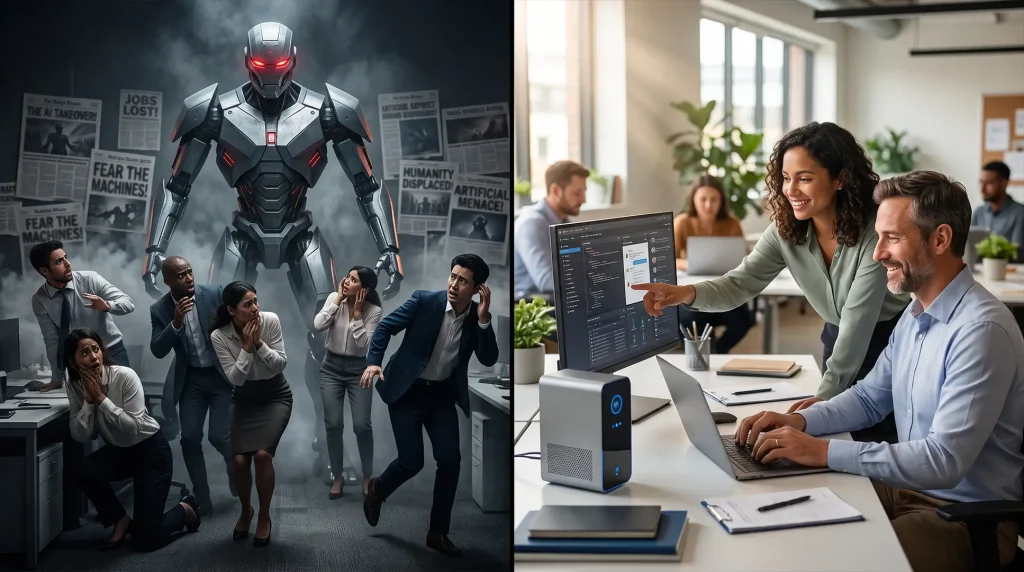
Myth: “AI is causing mass unemployment right now.” Reality: Aggregate unemployment has not spiked in the way some headlines imply. Anthropic’s own labor research found no clear economy-wide unemployment signal in the most AI-exposed occupations as of early 2026. The real, measurable effect so far is concentrated and generational — a hiring slowdown for the youngest workers in exposed fields — not a broad-based wave of job losses across the whole workforce.
Myth: “AI can already do most jobs completely on its own.” Reality: Even in the highest-performing studies, AI systems could only complete complex, multi-hour, real-world tasks reliably about 45% of the time via API, dropping from a 60% success rate on shorter, sub-hour tasks — nowhere near consistent enough for full unsupervised replacement of most skilled roles.
Myth: “Creative work is uniquely doomed.” Reality: The data is genuinely split by tier. Commodity, template-driven creative work (basic stock assets, formulaic layouts) is shrinking measurably. But surveyed businesses are actually increasing design budgets overall, and roles requiring strategic thinking, brand judgment, and client relationships are growing, not disappearing.
Myth: “This is completely unprecedented and history has nothing to teach us.” Reality: Every major wave of automation — textile machinery, the assembly line, computers — triggered nearly identical fears, nearly identical short-term pain for specific worker groups, and nearly identical debates among economists about whether “this time is different.” History doesn’t prove AI will follow the same script, but it’s a reason for humility about confident predictions in either direction.
Myth: “Older, more experienced workers are the safest from AI.” Reality: The opposite pattern shows up in the entry-level hiring data — older workers in AI-exposed occupations have held steady or grown, while the youngest workers in the same occupations have seen employment fall sharply. Experience and existing professional relationships appear to be more protective than seniority alone.
Career Impact: Who Is Most Exposed

Based on the occupational and task-level research above, exposure clusters in a few consistent patterns rather than along simple “creative vs. technical” lines:
Highest exposure — routine, rules-based, high-volume tasks:
- Data entry, basic customer service and support, telemarketing, medical transcription and coding, entry-level paralegal research, template-based graphic design, basic stock photography, and commodity copywriting.
- These roles share a common trait: the work is largely made up of tasks that are well-documented, repetitive, and don’t require ongoing human judgment or relationship management.
Moderate exposure — parts of the job automatable, parts not:
- Junior software development, junior video editing, market research, sales development, and technical writing. In these fields, specific tasks (drafting, first-pass editing, summarizing research) are increasingly AI-assisted, but the roles as a whole still require human review, client communication, or creative judgment that current models handle unreliably.
Lower exposure — judgment, trust, physical presence, or strategic relationships:
- Senior creative direction, brand strategy, UX research grounded in direct user contact, skilled trades, healthcare delivery requiring physical presence, and roles built primarily around long-term client or team trust.
- UX and product design roles, for example, are projected to grow around 16% through 2034 — much faster than execution-heavy graphic design roles growing only 2–3% — largely because they’re built around exactly the kind of ongoing human judgment and stakeholder relationships that are hardest to automate.
The one factor that matters more than industry: career stage. Across nearly every study reviewed here, the sharpest, most consistent effect isn’t which industry someone works in — it’s how early they are in their career within an exposed field. The practical implication for anyone starting out in a creative or knowledge-work career in 2026 is that building visible, portfolio-level judgment and specialization early — rather than relying on entry-level task volume to prove your value — has become more important, not less.
Business Impact: Why Companies Are Making This Bet

For businesses, the calculation driving AI adoption isn’t really “replace humans” as an end goal — it’s cost, speed, and margin, with headcount reduction as a downstream consequence in some cases and not others.
The MIT Initiative on the Digital Economy frames this as a spectrum rather than a binary switch: full automation only makes sense for tasks that are low-complexity and made up of few sub-steps; tasks with many interdependent sub-steps and high complexity still favor limited automation or pure augmentation, because the cost of deploying and maintaining AI systems for unreliable, high-stakes work often isn’t worth the ROI.
That nuance shows up starkly in the data: a 2025 MIT report found that despite nearly $40 billion invested in generative AI initiatives, 95% of organizations were seeing zero measurable return — and a 2026 NBER working paper found that eight in ten senior business executives report AI has had no measurable impact at all on their organization’s employment or productivity. At the same time, a smaller group of companies — concentrated in tech, logistics, and customer support — are seeing large enough returns to justify real headcount changes, which is why the layoff headlines and the “no impact” survey data can both be accurate simultaneously: the effect is not evenly distributed across the economy.
For creative and marketing-adjacent businesses specifically, the Clutch.co 2026 industry data suggests the “AI will crush the design industry” narrative doesn’t match actual spending behavior — most businesses are holding or increasing design budgets, not cutting them, even as they simultaneously expect designers to be more AI-fluent than before.
Future Predictions (2026–2030)
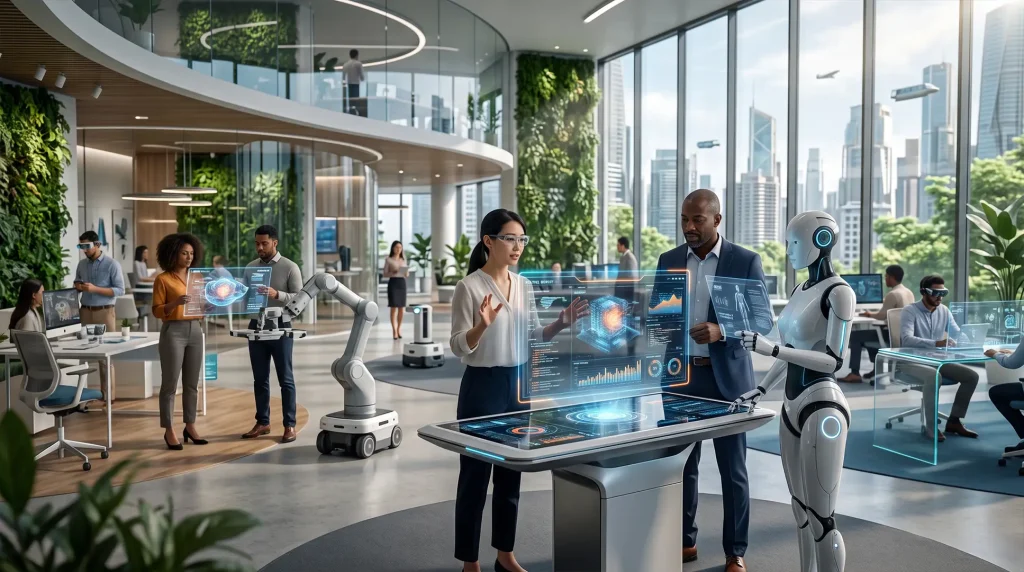
- Net job numbers likely stay positive on paper, but distribution gets worse before it gets better. Most major forecasts (WEF, Goldman Sachs) still project more roles created than destroyed through 2030, but the entry-level hiring gap suggests the people losing roles are unlikely to be the same people filling the new ones without active reskilling support — closing that gap is described by multiple labor analysts as the defining workforce challenge of the next few years.
- Task-completion capability keeps climbing, but reliability lags behind. MIT’s task-modeling research projects AI could handle 80–95% of text-based tasks at a “good enough” level by 2029 — but “good enough to pass a spot check” and “reliable enough to run without human oversight” remain very different bars, and the gap between them is where most human jobs are likely to persist longest.
- The augmentation-to-automation migration continues. As more companies move from assistant-style chat tools toward rigid, rule-based API and agent workflows, Anthropic’s own research suggests the share of purely automated (rather than human-assisted) work is likely to keep rising, particularly in customer service, sales operations, and back-office processing.
- Creative work bifurcates further. Expect continued decline in commodity, template, and stock-asset work, alongside continued growth in strategic, brand-level, and highly specialized creative and UX roles — meaning the total number of “creative jobs” may look stable in aggregate statistics while the actual nature and pay structure of those jobs changes substantially underneath that headline number.
- AI literacy becomes a baseline expectation, not a differentiator. With AI-skill job listings already up from single digits to roughly a third of design postings in two years, most labor-market researchers expect AI fluency to shift from a resume advantage to a basic job requirement across most knowledge-work fields well before 2030.
FAQ’s
Conclusion
“Is AI replacing humans?” is really two different questions wearing one headline. As a species-level, mass-unemployment claim, the current data doesn’t support it — global and U.S. employment overall has kept growing, and most economists studying real payroll and usage data, not projections, haven’t found a broad unemployment signal yet. As a task-level and entry-level-hiring claim, the data increasingly does support it — routine work is being automated at scale, commodity creative work is shrinking, and the youngest workers in AI-exposed fields are being hired at meaningfully lower rates than just a few years ago.


